The Perfect 7-Day Algeria Itinerary: A Day-by-Day Tourist Travel Plan for First-Time Visitors (Sahara, Algiers & Roman Ruins)

The first time I stood in the dunes near Djanet at sunrise, the sand wasn’t the postcard orange everyone Pins — it was pale gold shifting to rose, and the silence was so complete I could hear my own pulse. That’s the thing about Algeria. It’s Africa’s largest country, it sits three hours from Rome by plane, and almost nobody you know has been there. That’s exactly why you should go now.
This Algeria travel itinerary is built for first-timers who want the three iconic backdrops — the Sahara, the Mediterranean capital of Algiers, and the astonishing Roman ruins at Timgad and Djémila — without spending the whole trip on buses. It’s realistic, it’s paced for actual humans, and it flags the mistakes that quietly wreck first trips here.
Before You Book: The Non-Negotiables
Algeria is not a walk-up destination like Morocco. Two things shape your entire plan:
1. The visa and the “invitation.” Most nationalities need a visa arranged before arrival. The practical route for tourists is a tour operator or hotel that issues an invitation letter (prise en charge), which you submit with your visa application. This is why nearly everyone books at least the Sahara portion through a local agency — it solves the paperwork and the logistics in one move.
2. The desert requires a guide and permits. The Tassili n’Ajjer and Hoggar regions (Djanet, Tamanrasset) are only accessible with a licensed local agency. You cannot self-drive the deep Sahara. This isn’t bureaucracy for its own sake — navigation, fuel, and safety genuinely need locals.
Budget-wise, Algeria is cash-heavy. Bring euros and change them via your hotel or agency — the unofficial rate is dramatically better than the bank rate, and this is completely normal practice. Cards work in upscale Algiers hotels and little else.
Quick planning snapshot
| Element | Reality on the ground |
|---|---|
| Best months | October–April (avoid Sahara May–Sept heat) |
| Getting in | Fly into Algiers (ALG); domestic flights to Djanet/Tamanrasset |
| Sahara access | Guided only, permits handled by agency |
| Payment | Cash (euros to exchange), cards rare |
| Language | Arabic + French everywhere; English limited |
| Daily budget (mid-range) | €80–150/day incl. Sahara tour share |
| SIM card | Djezzy or Ooredoo, cheap, need passport |
Vetted Local Operators for the Sahara
The single most useful thing I can hand you: names. The Djanet-based desert specialists are the ones who actually issue the prise en charge invitation letter that unlocks your visa, so contact them early — the letter can take one to three weeks to process.
- Tanezrouft Voyages (Djanet) — a long-established Djanet agency running Tassili n’Ajjer and Tadrart Rouge circuits; the kind of operator accustomed to preparing invitation letters for foreign clients.
- Admer Voyages / Zeriba Voyages (Djanet) — Djanet-region operators focused on Tadrart and Tassili treks and 4×4 circuits, again with experience handling tourist visa invitations.
- Hoggar / Tamanrasset side: if you pivot to the Hoggar, Akar Akar Voyages and similar Tamanrasset agencies run the Assekrem and Atakor peaks.
A note on practice, not promotion: agency names, ownership, and reliability shift year to year in Algeria. Email two or three, compare how fast and clearly they answer, ask specifically whether they issue the invitation letter and how long it takes, and get the full quote in writing (flights included or not, camp nights, guide, meals). The operator who replies precisely to a detailed email is usually the one who runs a tight trip.
Why This Route Works
The temptation is to zigzag across a country that’s bigger than Western Europe. Don’t. This itinerary uses one domestic flight to reach the desert and keeps the Roman ruins and Algiers on the northern coastal corridor, where roads and trains are decent.
The logic:
– Days 1–2: Algiers — arrival buffer, culture, the visual “white city” shots.
– Days 3–5: Fly south to the Sahara (Djanet region) — the trip’s emotional peak.
– Days 6–7: Return north for Timgad (or Djémila) Roman ruins and a final Algiers evening.
If you only have 5 days, cut the Roman ruins and keep Algiers + Sahara. If you have 10, you have real room to breathe — see the trade-offs section for how I’d actually spend the extra days.
A Note on Ramadan
If your dates land in Ramadan (the Islamic calendar shifts roughly 11 days earlier each year, so check it against your travel month), plan differently rather than avoiding it. Most restaurants and cafés stay shuttered until sunset, so daytime meals become a matter of stocking up in shops or leaning on your hotel and agency. Pacing changes too: locals fast through the day, energy dips in the hot afternoon, and things quicken again after dark. Build lighter daytime plans and expect life to switch on at night.
The upside is genuine. Iftar — the sunset meal breaking the fast — is one of the most generous social moments in Algerian life, and travelers are frequently invited to join. Accepting is one of the warmest ways to actually meet people here. In the desert, agencies simply shift the day: excursions early, then a long communal iftar as the light drops.
Day 1: Algiers — The White City on the Bay
Land at Houari Boumediene Airport. Grab a Djezzy SIM in arrivals, exchange your first €100–150, and taxi into the center (roughly 1,500–2,500 DZD, agree the price first).
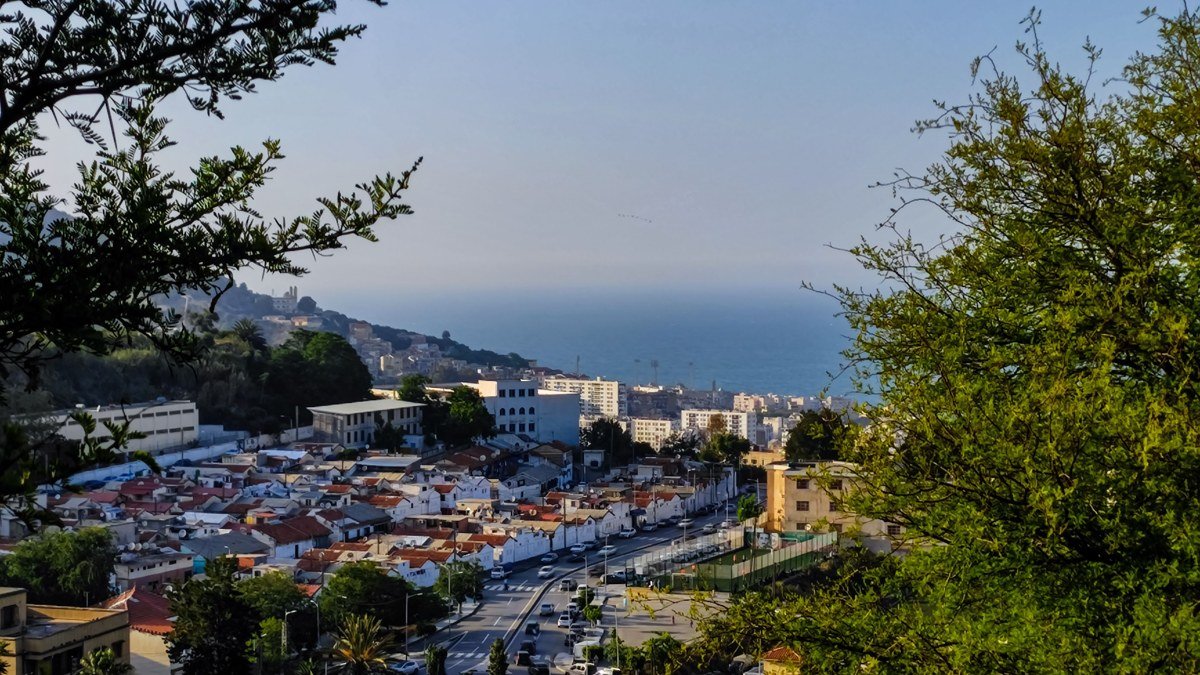
Base yourself in the central/Sidi Fredj or waterfront area. Spend the afternoon walking the French colonial boulevards — the wedding-cake white facades cascading down to the bay are the “Alger la Blanche” you saw on Pinterest, and late-afternoon light makes them glow.
Evening: dinner along the seafront. Try a grilled fish spot; expect around 1,200–2,000 DZD for a full meal.
Insider tip: Photography of government buildings, ports, and police is genuinely sensitive here. Ask before shooting anything official. Locals are warm and often thrilled you visited — but the state is camera-shy.
Day 2: The Casbah, the Basilica, and Roman Foundations
Morning: the Casbah of Algiers, a UNESCO World Heritage site. It’s a steep, tangled Ottoman-era medina — genuinely atmospheric and genuinely confusing. Hire a local guide (arrange through your hotel, ~3,000–5,000 DZD for a couple of hours). Wandering alone you’ll get lost and miss the history; with a guide the alleys open up into courtyards, tiny mosques, and rooftop views over the harbor.
Casbah guides generally start rounds from mid-morning and stop by late afternoon — think roughly 9:00 to 16:00–17:00 — but there’s no ticket window; you arrange through a hotel or a guide association the day before. In midsummer heat guides start earlier; in winter the useful light is gone by late afternoon. Confirm same-day, because hours flex with season and demand.
Afternoon: Notre-Dame d’Afrique, the cliff-top basilica overlooking the Mediterranean — one of the most Pinnable spots in the city. Then the Bardo Museum (the ethnographic and prehistory museum; typically open roughly 9:00–17:00, closed one weekday, though days shift — verify before you go) or the Martyrs’ Memorial (Maqam Echahid), whose three towering concrete palm fronds dominate the skyline.
Evening: pack light for the desert. You’ll leave clothes in Algiers if your agency lets you store luggage — the Sahara run needs less than you think.
Insider tip: Book your domestic flight to Djanet (via Air Algérie) weeks ahead. Seats are limited, they sell out, and prices swing. Budget roughly €90–160 each way.
Day 3: Fly South to Djanet — Into the Tassili n’Ajjer
Morning flight from Algiers to Djanet (usually 2–2.5 hours; sometimes via a stop). The moment you step off, the temperature, the light, and the pace change completely.
Your agency’s 4×4 meets you at Djanet’s small airport. Djanet is a palm-oasis town — your gateway to Tassili n’Ajjer National Park, a UNESCO site famous for sandstone “forests,” natural arches, and some of the oldest prehistoric rock art on Earth (dating back thousands of years).
Where you actually sleep. Two realistic options. In town, Djanet has modest guesthouses and small hotels — think family-run auberges and simple mid-range places like the well-known Zeriba-style guesthouses and the town’s few hotels; expect a clean room, a fan or basic AC, tiled floors, and hot water that sometimes cooperates, in the 4,000–8,000 DZD range. Out in the sand, a typical mid-range desert camp is a cluster of low goat-hair or canvas tents around a central fire and eating area. Do not expect plumbing: toilets are usually a simple pit or dry latrine set apart from the tents, sometimes a screened bucket-style arrangement, and “washing” is a jerrycan of water. Sleeping is on mattresses and thick blankets on the sand — warmer than it sounds, but you’ll want your own liner and a hat for the cold hours.
The agency dinner situation, honestly. On a guided package, meals are included and cooked by your guide and crew over the fire — there is no menu and no ordering. Dinner is typically a communal tagine, grilled meat, bread baked in the sand (taguella), rice or couscous, and the endless sweet mint tea ritual. You eat together, seated on rugs. If you have dietary needs, tell the agency before you fly, not at the camp — resupply out here is impossible.
Afternoon: a gentle first excursion — usually the dunes and rock formations near town, timed for sunset. This is your acclimatization day; don’t overplan it.
What to actually pack for the desert:
– Layers — days can hit 25°C+, nights drop near freezing in winter
– A real headscarf/shesh (buy one locally, ~500–1,000 DZD, and have someone show you to wrap it)
– Sunglasses, high-SPF, lip balm
– A power bank (no reliable electricity in camps)
– Cash — nothing out here takes cards
– Closed shoes for rock, sandals for camp
– Wet wipes and hand sanitizer — the latrine reality makes them essential
Day 4: Deep Desert — Rock Art, Arches, and Silence
This is the day the trip earns its place on your wall. A full-day 4×4 excursion into the Tadrart Rouge or toward the plateau, depending on your operator’s route.
Expect:
– Towering red rock canyons that turn crimson at golden hour
– Prehistoric rock engravings and paintings — your guide will find panels you’d walk straight past
– Sculpted arches and “moon valley” landscapes
– Tea brewed over a fire, which is a ritual, not a pit stop — accept it, sit down, slow down
Honest expectation-setting: distances are long and roads are non-existent. You’ll spend real hours in the vehicle. This is not a downside — it’s the desert — but if you get carsick, take medication and sit up front.
Night: desert camp. Dinner is usually a communal tagine or grilled meat cooked in the sand. Stargazing after is the memory you’ll keep.
Day 5: Sunrise Dunes, Then North
Wake for sunrise over the dunes — worth the cold. This is the single most photographed moment of the trip, and the light lasts maybe 30 minutes, so be positioned early.
Late morning, return to Djanet for your flight back to Algiers. Realistically, this is a travel-heavy afternoon. Build in buffer — Sahara domestic flights are occasionally delayed or shuffled, and you do not want a tight onward connection.
Overnight in Algiers or, better, position yourself for the Roman ruins the next day.
Insider tip: If your Djanet flight lands late, don’t try to reach Timgad the same night. It’s a long haul east. Sleep in Algiers, start fresh.
If your Djanet flight is cancelled
It happens — Air Algérie’s southern routes are the flakiest part of any Algeria trip. Have a plan before it does:
- The realistic first fallback is patience, not rerouting. Djanet flights don’t run daily, so a cancellation often means catching the next scheduled service a day or two later. If the desert is your priority, absorb the delay in Djanet rather than scrambling — your agency can usually extend a camp night or guesthouse stay cheaply.
- Pivoting to Tamanrasset is rarely quick. Tam is a separate flight network and its own permit/agency arrangement — you can’t casually swap Djanet for Tam mid-trip unless your operator can set up guides and permits on the fly. Treat this as a Plan C, not B.
- If the desert falls through entirely, salvage the trip in the north. Extend Algiers, add the Roman ruins you’d otherwise have skipped, or arrange a guided day trip toward Ghardaïa and the M’zab Valley — the pentapolis of fortified Mzab towns is reachable by a shorter domestic hop or a long drive, and gives you a genuine, distinctive Sahara-edge experience without the deep-desert logistics. It’s not the Tassili, but it’s a real consolation rather than a wasted week.
Day 6, Option A: Timgad — the “Pompeii of Africa”
For a first-timer, Timgad is the more complete “wow” — a grid-planned Roman colony founded under Trajan, sitting on a flat, open plain near Batna. The Arch of Trajan, the paved main street (decumanus), the theater and the forum are exactly what people picture when they imagine Roman ruins, minus the crowds of Italy.
Getting there: fly Algiers→Batna, then it’s roughly a 35 km drive to the site. Many first-timers instead arrange a car with driver through their agency — expensive but painless, roughly €80–150/day.
The site is open-air and generally runs on daylight hours — expect something like 8:00/9:00 until 16:00–17:00, shorter in winter, and hours do shift seasonally, so confirm locally. Entry fees are minimal (a few hundred dinars), and a local guide waiting at the entrance adds real depth for a small fee. Bring water, a hat, and time; Timgad rewards slow exploration.
Insider tip: Go mid-week and mid-afternoon. You may have entire Roman streets to yourself — and that emptiness is exactly what makes the photos feel discovered rather than touristy.
Overnight in Batna (simple hotels, ~4,000–8,000 DZD).
Day 6, Option B: Djémila — Ruins Draped Over Green Hills
If scenery and mosaics move you more than scale, choose Djémila instead. Where Timgad is a flat, rational grid, Djémila (ancient Cuicul) spills down a dramatic sloped valley near Sétif, its temples, forum, and colonnaded streets following the contours of the hills — greener and more picturesque, especially in spring. Its glory is the on-site museum’s mosaics, some of the finest preserved in situ anywhere in North Africa.
Getting there: fly or take the train Algiers→Sétif (the northern-line trains are comfortable and cheap, if slower), then roughly a 50 km drive to the site. As with Timgad, expect daylight opening hours — broadly 8:00/9:00 to late afternoon, shorter in winter — with the same seasonal caveat, and a small entry fee plus optional guide at the gate. Spend the afternoon walking the terraces down to the museum, then overnight in Sétif (~4,000–8,000 DZD).
Pick one. Timgad and Djémila are on opposite sides of the northern interior, and trying to squeeze both into a 7-day plan turns Day 6 into a day spent entirely in transit.
Day 7: Back to Algiers — Final Coast and Departure
Return to Algiers by morning train or flight. Use your last hours for whatever you missed: the Jardin d’Essai du Hamma botanical garden, a final seafront lunch, or souvenir shopping for dates, silver, and desert textiles in the central markets.
Aim to be at the airport 3 hours before an international flight — check-in and security here can be slow.
A Fully Worked Sample Itinerary (Copy This)
| Day | Base | Plan | Rough cost/person |
|---|---|---|---|
| 1 | Algiers | Arrive, seafront, colonial center | €50 (hotel + food) |
| 2 | Algiers | Casbah + guide, Notre-Dame d’Afrique | €45 |
| 3 | Djanet | Fly south, sunset dunes | €130 (flight) + tour |
| 4 | Sahara camp | Full-day 4×4, rock art, camp | tour incl. |
| 5 | Algiers | Sunrise dunes, fly north | €130 (flight) |
| 6 | Batna/Sétif | Train/flight east, Timgad or Djémila | €60 + transfer |
| 7 | Algiers | Return, final lunch, depart | €40 |
Realistic total for 7 days (mid-range): roughly €900–1,300 per person, with the Sahara guided portion (3-day/2-night package, ~€300–500) and two domestic flights being the biggest chunks. Backpacker-frugal you can shave; solo travelers pay more because desert tours price for groups.
Common Mistakes First-Timers Make
Trying to do the Sahara from Algiers as a day trip. You can’t. The real desert is a two-hour flight away. The “dunes” near the coast are not the Tassili. Fly to Djanet or Tamanrasset or skip the desert honestly.
Booking flights and desert tour separately with no buffer. Domestic flights shift. If your only Sahara camp night hinges on a flight that slips, the whole trip dominoes. Give yourself a spare half-day.
Underestimating cold desert nights. People pack for “the Sahara” imagining heat and freeze at 2 a.m. in December. Bring a fleece and a hat.
Assuming cards work. They mostly don’t. Arrive with enough euros to exchange for the whole trip.
Ignoring the two-currency-rate reality. Changing money at the official bank rate can cost you significantly versus the standard tourist exchange through hotels/agencies. Ask your operator how locals do it.
Photographing anything official. Ports, airports, police, government buildings — genuinely avoid it. People are lovely; the state apparatus is not.
Over-scheduling Algiers. It’s a big, hilly, traffic-clogged city. Two focused days beats three rushed ones.
Honest Trade-Offs
5 days vs. 7 vs. 10. With 5 days, don’t try to see it all — keep Algiers (2 days) and the Sahara (3 days) and drop the Roman ruins entirely; the desert is the reason to come, and a rushed ruins detour will cost you a camp night you’ll regret losing. 7 days is the sweet spot this itinerary is built around: Algiers, the desert, and one Roman site with buffer for the flaky Djanet flight. With 10 days, resist the urge to add a fourth region and instead deepen: spend a third and fourth night in the desert (a longer Tadrart trek changes the experience entirely — you stop treating it as a photo stop and start living in it), add the second Roman site you skipped, and give the M’zab Valley at Ghardaïa a proper two-day visit. Ten days spread thin across five regions is worse than ten days spent well across three.
Djanet vs. Tamanrasset. Djanet gives you the surreal Tadrart rock forests, arches, and the densest prehistoric rock art — the most Pinnable desert, and the easier logistics for a first trip. Tamanrasset gives you the volcanic Hoggar peaks and the famous Assekrem sunrise at the hermitage, a starker, higher-altitude experience. For a first Algeria trip, do Djanet; save the Hoggar for a return.
Solo vs. group, and what it does to cost. This is where the money actually moves. Desert tours are priced per vehicle, guide, and camp crew — fixed costs that a group of four splits four ways and a solo traveler swallows whole. A 3-day desert package that’s €300–400 per head at four people can climb toward €600+ solo. If you’re travelling alone and budget matters, ask your agency whether they can slot you into a scheduled departure with other travelers; the per-person price drops immediately. Two or three friends is the cost sweet spot — enough to split the fixed costs without the pacing compromises of a big group.
Independent vs. full package. Independent saves money and feels adventurous but eats time on logistics and visa paperwork. A package for the whole week costs more but removes every headache — for a first Algeria trip with only 7 days, I lean package.
Timgad vs. Djémila. If you want the definitive Roman city, Timgad. If you want mosaics and hillside drama, Djémila. Don’t try both in a 7-day plan — you’ll spend the day in transit.
Train vs. car with driver. Trains are cheap and scenic but slow and fixed-schedule. A private driver costs more but lets you photograph freely and adjust on the fly.
Your Actionable Takeaway
Do this in order, starting today: (1) email two or three licensed Djanet agencies (start with the operators named above) for a 3-day desert package plus a visa invitation letter, and compare how precisely they reply; (2) the moment your visa is confirmed, book Algiers→Djanet→Algiers domestic flights with a spare half-day of buffer; (3) pick Timgad or Djémila — not both — and lock your northern transfer; (4) arrive with €600–800 in cash to exchange.
Get those four things right and the rest of this itinerary falls into place — you’ll come home with the Sahara sunrise, the white bay of Algiers, and an empty Roman street that nobody in your feed has ever seen.