Morocco 5-Day Itinerary: Marrakech, Sahara & Fes One-Way (With Real Drive Times and What to Skip)

The moment you’ll remember isn’t the camel ride. It’s around 5:40 a.m. in a Sahara camp near Merzouga, when you climb the dune behind your tent barefoot because sand is cold at dawn, and watch the Erg Chebbi ridge turn from grey to bruised purple to burnt orange while your breath fogs. No one’s talking. That single hour justifies the entire drive.
The problem: most people try to cram that hour into a 7-day loop that leaves them exhausted and over-driven. This Morocco 5 day itinerary does the opposite. It picks two great cities — Marrakech and Fes — and threads them together through the desert, so every long drive earns its place. It’s built for the traveler who wants the postcard contrast (labyrinthine medinas one night, silent dunes the next) without pretending five days is enough to “see Morocco.”
Here’s how to make five days feel like ten, and where to stop that everyone else blows past.
The honest truth about a 5-day Morocco itinerary
Morocco is big, and the roads between its highlights are mountain roads. Marrakech to Merzouga (the Sahara gateway) is roughly 560 km and takes 8–9 hours of actual driving. Merzouga to Fes is another 460 km, about 7–8 hours. You cannot avoid these drives. You can only decide how to spend them.
So the core strategic choice for a 5-day trip is this:
- One-way it. Fly into Marrakech, out of Fes (or vice versa). This is the single best decision you can make. It saves you an entire backtracking day.
- Don’t loop. The classic Marrakech-return loop wastes 2 days retracing the same passes. On a 5-day budget, that’s a deal-breaker.
Airlines like Royal Air Maroc, Ryanair, and easyJet all serve both airports, and open-jaw tickets (into RAK, out of FEZ) are often barely more expensive than a round trip.
The route at a glance
| Day | Route | Driving | Sleep in |
|---|---|---|---|
| 1 | Arrive Marrakech | — | Marrakech riad |
| 2 | Marrakech → Aït Ben Haddou → Dades/Boumalne | ~7 hrs | Dades Gorge or Boumalne |
| 3 | Dades → Todra Gorge → Merzouga → camel to camp | ~5 hrs | Desert camp |
| 4 | Sunrise → Merzouga → Ifrane → Fes | ~8 hrs | Fes riad |
| 5 | Fes medina, depart | — | — |
Total driving over five days: roughly 20 hours. That sounds brutal, but it’s spread across three travel days with genuine, world-class stops breaking it up — and the scenery through the High Atlas is half the trip.
How to travel it: driver vs. self-drive vs. group tour
This choice shapes everything.
- Private driver (recommended). Expect roughly €90–150 per day for the car plus driver, split across your group, often including fuel. You get flexibility to stop for photos, no navigation stress on mountain switchbacks, and someone who can talk you into the good roadside stops. Book through your riad (the reliable default — they use drivers they trust and stake their reputation on it) or a vetted operator such as Sahara Services or Morocco Desert Trips, both long-established Merzouga-based agencies with English-speaking drivers. Whoever you book, insist on a written itinerary with named stops, a fixed fuel-inclusive price, and confirmation of whether tolls and the driver’s meals/lodging are included. “It depends on the day” is the answer that costs you €40 at the end.
- Self-drive. A rental runs €30–50/day. Roads are paved and generally fine, but night driving is genuinely dangerous (unlit trucks, pedestrians, livestock), and police speed checks are frequent — carry cash for the (usually legitimate) on-the-spot fines. Do this only if you’re a confident driver who enjoys the wheel.
- Group tour. Cheapest per head (€90–130 for a 3-day Marrakech-to-Fes desert tour), but you’re on someone else’s clock, in a shared minibus, at a large camp. Fine if budget is tight; frustrating if you value control.
For a 5-day trip, the private driver wins for most people. The time you save and the stops you unlock are worth it.
Day 1: Marrakech — land, then dive into the medina
Fly in early if you can. Drop your bags at a riad inside the medina — not a modern hotel in Gueliz. The whole point is to sleep inside the old walls.
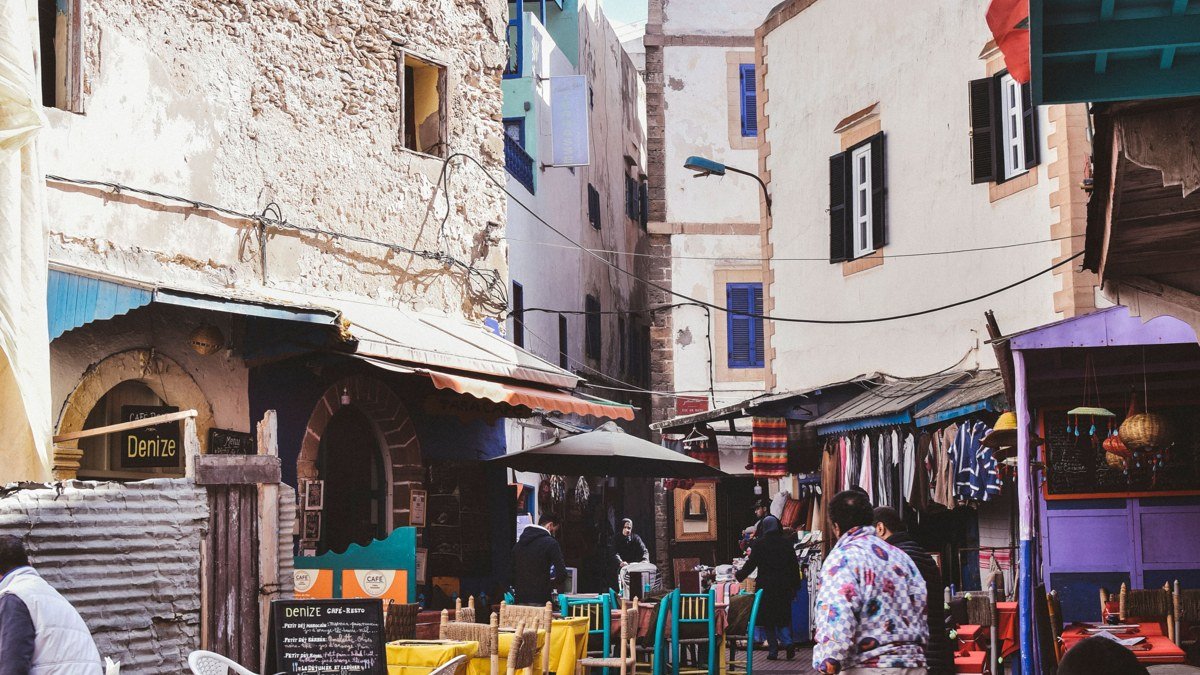
Afternoon: Get lost on purpose in the souks north of Jemaa el-Fnaa. Aim loosely for the Medersa Ben Youssef (the restored Quranic school with the tilework everyone photographs), then break off from the tourist current and walk south into the Mellah, the old Jewish quarter. The spice and produce market at Rahba Kedima (“the old square”) is where locals actually buy — apothecary stalls piled with dried chameleons, ras el hanout ground to order, and cheap woven baskets a fraction of souk prices. Duck into one of the working foundouks off Rue Dar el Bacha — the merchants’ courtyards where caravans once stabled animals downstairs and slept upstairs. Most tourists walk straight past the plain wooden doors; step through and you’ll find galleried courtyards now used by lantern-makers and leather workers, quiet and free.
Evening: Jemaa el-Fnaa at dusk. The square transforms into a food-stall carnival. Eat where locals queue, not where a tout grabs your arm. A rooftop café (many ring the square) gets you the view and the call to prayer over the chaos without the hard sell.
Where to sleep in Marrakech
- Budget — Riad Dar Zaman: Simple, spotless, family-run near Bab Doukkala; the rooftop breakfast (fresh msemen, mint tea) and the owner’s willingness to draw you a walking map earn it well above its price.
- Mid-range — Riad Le Clos des Arts: Tucked in the northern medina near Ben Youssef, artist-decorated rooms and a plunge-pool courtyard that’s genuinely cool in the afternoon heat.
Two universal riad rules a first-timer misses:
- Ask the riad to arrange a porter to meet you at the taxi drop point. Cars can’t reach most riads; you’ll be walking narrow derbs with luggage and it’s easy to get lost. This service is often free or a few euros.
- Confirm your riad has air conditioning if you’re traveling April–October. “Fan only” is a sweat sentence in Marrakech summer.
Rough cost: Mid-range riad €60–110/night. Dinner at the square €5–10. Medersa entry ~70 MAD (about €6.50).
Day 2: Over the Atlas to Aït Ben Haddou and the gorges
This is the big scenic driving day, and it’s spectacular. Leave by 8 a.m.
Tizi n’Tichka pass: The road climbs to over 2,200 m through switchbacks with pull-offs at every bend. Your driver knows the good ones. It’s cold at the top even when Marrakech was hot — bring a layer.
Aït Ben Haddou (mid-morning): This is the fortified mud-brick ksar you’ve seen in Gladiator and Game of Thrones. Cross the little river (or the sandbag bridge) and climb through the earthen kasbah to the granary at the top for the panorama back over the valley. Give it 90 minutes to 2 hours. Go earlier rather than later to beat the tour-bus wave from Ouarzazate.
What to skip, what not to: Ouarzazate’s Atlas Studios is a paid tour of dusty film sets — skippable unless you’re a superfan. The drive east into the Dades Gorge is not. As the light goes golden, the Dades snakes through red rock and the famous hairpin “monkey fingers” road appears. Have your driver stop at the viewpoint café above the switchbacks. If your day is running long, don’t sweat missing the Valley of the Roses (M’Goun valley) — it’s a genuine detour that only pays off in the two-week rose harvest (late April–May), when the fields are picked at dawn for distilling and the festival at Kelaat M’Gouna is worth timing a trip around. Outside that window it’s a pretty but unremarkable side road, and the Dades is the better use of fading light.
Sleep: A kasbah hotel in the Dades Gorge or around Boumalne Dades.
- Budget — Auberge Chez Pierre… skip that; go Auberge Restaurant Timzzillite: Perched right at the top of the monkey-fingers switchbacks with a terrace over the whole gorge — the view alone is the reason to stay.
- Mid-range — Xaluca Dades (Boumalne): Larger and more polished, with heated pool and a big dinner buffet — a soft landing before the desert stretch.
These are cheaper and more atmospheric than staying in Ouarzazate, and they set up Day 3 perfectly. Cost: €40–70/night, usually with dinner included (worth it — options are limited out here).
Day 3: Todra Gorge, then camel into the Sahara
Another early start, but a shorter drive.
Todra Gorge (morning): Sheer 300-meter canyon walls with a stream running through a gap barely wide enough for the road. Walk in among the rock climbers, then get moving.
The long stretch to Merzouga runs through increasingly barren, cinematic desert. Stop in Rissani — the nobody-talks-about gem — for the Sunday/Tuesday/Thursday souk if timing lines up, and to try madfouna (often called “Berber pizza”), a stuffed flatbread baked in ashes. It’s a real local town, not a tourist stage set.
Arrive Merzouga by mid-afternoon. Your camp will meet you at the edge of Erg Chebbi. Now the good part:
Camel trek at ~4:30–5 p.m. A 60–90 minute ride into the dunes, timed so you’re on a high dune for sunset. Then dinner (tagine, always tagine), drumming around a fire, and a sky with more stars than you’ve seen in your life because there’s zero light pollution.
How to pick a desert camp (this matters a lot)
Camps range from €30 backpacker bivouacs to €250+ “luxury” tents with ensuite bathrooms and proper beds. The gap in comfort is enormous.
- Standard camp (€40–80 pp): Shared toilets, basic mattresses, communal dinner. Perfectly fine for one night.
- Luxury camp (€120–250 pp): Private tent, real bed, ensuite hot shower, sometimes a plunge pool. If you splurge one night this whole trip, do it here.
Non-obvious tip: Ask whether your camp is inside Erg Chebbi (the tall dunes) or on the flat scrub at the edge. Some “desert camps” are barely off the road. You want the dunes around you, not in the distance.
Day 4: Sunrise, then the long haul north to Fes
Wake before dawn. This is the hour I described at the top. Climb the nearest dune, watch the sunrise, take the photos, be quiet. Some camps offer a sunrise camel ride back; walking is fine and free.
Then comes the trip’s toughest drive: Merzouga to Fes, 7–8 hours. Break it strategically:
- Midelt for lunch — the rough midpoint, known for apples and a decent stop.
- The cedar forest near Azrou, where you can see (semi-wild, sometimes overly-tame) Barbary macaques. Don’t feed them; it’s bad for them and they’ll mob you.
- Ifrane — the “Switzerland of Morocco,” an Alpine-style town with chalets and a famous stone lion statue. Surreal and worth a 20-minute coffee stop for the whiplash of it after two days of desert.
Arrive Fes evening. Check into a riad in Fes el-Bali (the old medina). Rest — you’ve earned it. Grab dinner near your riad; the medina at night is atmospheric but disorienting, so don’t wander far without a plan.
Where to sleep in Fes
- Budget — Dar Bensouda… too big; go Riad Verus: A social, backpacker-friendly riad near Bab Boujloud with a roof terrace, honest prices, and staff who’ll walk you to the medina gate so you don’t get lost on night one.
- Mid-range — Riad Fes Baraka: Deep in Fes el-Bali near the Qarawiyyin, with intricate zellij, a genuinely quiet courtyard, and a rooftop breakfast overlooking the medina rooftops.
Day 5: Fes medina, the deepest labyrinth in the world
Fes el-Bali has some 9,000+ lanes and is often called the world’s largest car-free urban area. You will get lost. Embrace it, but hire a licensed guide for the morning (~€25–40 for a half day) — this is the one city where a guide genuinely earns their fee, both for navigation and context.
Hit:
- The Chouara Tanneries — the honeycomb of dye pits. Go first thing, around 9–9:30 a.m.: the morning light hits the pits before the shadows swing across them, the smell is milder before the day heats up, and you’ll beat the mid-morning crowds jostling for the same terrace railings. Leather shops give you a sprig of mint for the smell and a terrace view. You’re expected to be pitched leather afterward; browsing is fine, buying isn’t obligatory.
- Al-Qarawiyyin — founded in the 9th century, considered one of the oldest continually operating universities in the world. You can admire the courtyard/entrances (interior access is limited for non-Muslims).
- Bou Inania Medersa and the Blue Gate (Bab Bou Jeloud) for the tile and cedar carving.
The insider detour: slip off the main artery to Place Seffarine, the small triangular square ringed by coppersmiths. From dawn you’ll hear it before you see it — the arrhythmic hammering of men beating tea trays, couscous pots, and cauldrons by hand, exactly as they have for centuries. Order a coffee at the tiny café on the corner, sit on a stool, and watch. It’s one of the few places in the medina where the work isn’t performed for tourists. A few doors down, tucked into the old Seffarine Medersa’s shade, is the kind of scene that no guided march past the tanneries will give you.
Then fly out of Fes–Saïss (FEZ) in the afternoon or evening. If your flight is late, a slow lunch on a riad rooftop is the perfect send-off.
What to eat, specifically
- Marrakech: Mechoui — slow-roasted lamb pulled from a pit oven, sold by weight at the stalls near the Mechoui Alley off Jemaa el-Fnaa. Order it with cumin and salt on the side.
- The Atlas roadside: Amlou — an almond-argan-honey spread, best bought at a women’s argan co-operative on the road east of Marrakech, where you can watch the nuts cracked and ground by hand.
- Rissani / the desert: Madfouna — the ash-baked stuffed flatbread; eat it hot, straight from the bakery.
- Fes: Msemen — flaky griddled square pancakes, best from a morning cart with honey or cheese; and bissara, a warming split-pea soup locals eat for breakfast in winter.
Common mistakes (the non-obvious ones)
- Doing the round-trip loop. Backtracking Merzouga → Marrakech burns a whole day. One-way it, out of Fes.
- Under-budgeting drive time. People see “Marrakech to desert” and imagine three hours. It’s eight or nine. Plan your energy accordingly.
- Booking the cheapest desert camp sight unseen. The comfort range is massive. Read recent reviews specifically about the tents and whether it’s in the dunes.
- Wearing sandals in the medina. The lanes are uneven, wet in spots, and mopeds fly through. Closed shoes.
- Not carrying cash. Rural stops, camps, and small cafés are cash-only. Withdraw dirham in Marrakech/Fes; the desert has almost no ATMs.
- Arriving with no offline map. Download the Fes and Marrakech medinas on Maps.me or Google Maps offline. GPS still struggles in the tightest lanes, but it saves you.
- Trusting anyone who says “that way is closed, follow me.” In both medinas this is a classic redirect-to-a-shop scam. Politely decline and keep going.
When this itinerary works — and when it doesn’t
Do this 5-day version if: you have a hard time limit, you want the medina-and-desert contrast above all else, and you’re okay with three real driving days.
Do a 7-day version instead if: you want to slow down, add the coast (Essaouira) or the Ourika Valley, or you get carsick on mountain roads and need buffer days.
Trade-off to accept: you’re not “seeing Chefchaouen, the coast, and the Sahara” in five days. That’s a highlight reel that leaves everyone frazzled. This route does two great things well.
Practical extras
- Best months: March–May and September–November hit the sweet spot. Summer (June–August) desert heat is punishing — daytime highs near Merzouga regularly top 45°C. December–February days are pleasant but Sahara nights drop near or below freezing, and the Tizi n’Tichka pass can close briefly after snow.
- The desert-to-mountain packing note: This route swings from High Atlas passes above 2,200 m to Saharan afternoons and back to Middle Atlas cedar forest, sometimes in a single day. Pack in layers you can peel on and off in the car: a warm fleece or down layer for the pass and the pre-dawn dune (it can be 5°C at sunrise even in shoulder season), a light long-sleeve for sun cover during the day, and a scarf or shesh that doubles as sun protection, dust filter, and dune-cold neck warmer. Nights in the desert camp are colder than the brochure photos suggest — the fleece is not optional.
- SIM card: Buy a prepaid Maroc Telecom, Orange, or inwi SIM at either airport arrivals hall — bring your passport, expect to pay under €10 for a generous data bundle, and have the vendor activate and test it before you walk away. Data coverage is solid in the cities and along the main roads but patchy in the deep desert, so download your offline maps before you leave Marrakech. An eSIM (Airalo and similar) works too if your phone supports it and you’d rather skip the counter.
- Tipping: Budget for it — driver (€8–15/day is generous), guides, camp staff, restaurant help. Small dirham notes matter.
- Dress: Modest but not restrictive. Shoulders and knees covered is respectful, especially in Fes.
- Water: Bottled everywhere; carry more than you think for the desert day.
The takeaway
Book an open-jaw flight (into Marrakech, out of Fes) tonight — that single decision unlocks the whole tight 5-day format. Then lock in a private driver with a written, fuel-inclusive itinerary, splurge on one dune-side luxury camp for Night 3, and protect your Day 4 sunrise at all costs. Everything else on this route is scenery between those anchors, and the scenery happens to be some of the best on earth. Five days, two ancient cities, one silent dawn on the sand — done right, that’s not a compromise. It’s the trip.