
Picture the harbor at Kastellorizo just after sunrise: Ottoman-era mansions in deep terracotta, cobalt, and seafoam green, their wooden balconies suspended over water so clear it reads as turquoise even on an overcast morning. The population of the entire island is smaller than a single apartment block in Athens. This is the kind of place these nine islands deliver, and none of them require you to fight a crowd for the shot. The built environments here are so locally specific, so shaped by particular histories and geologies, that seasoned travelers do a double-take at their own photos.
1. Folegandros
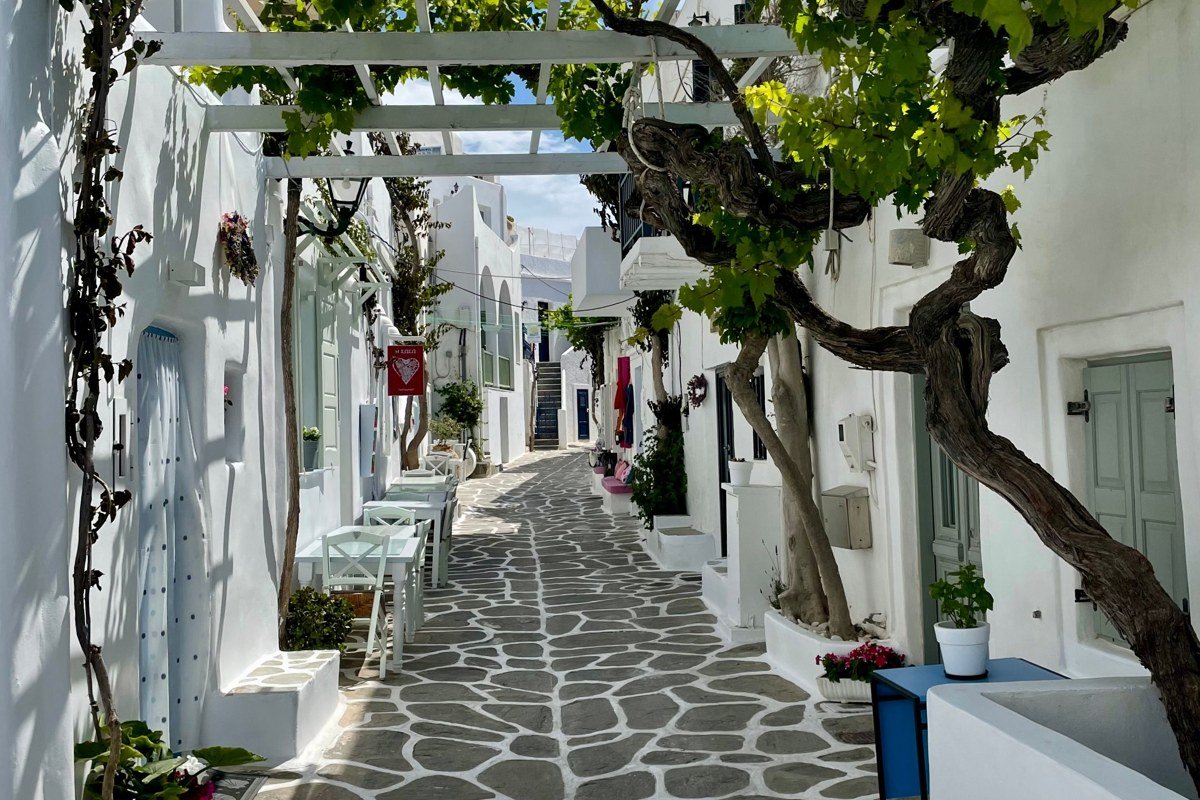
Folegandros sits on a sheer cliff above the Aegean, and the main village, called Chora, is essentially a fortified medieval settlement designed to be invisible from the sea. The outer ring of houses forms the castle wall, their back walls blank and windowless facing outward, while the interior opens into a warren of flower-draped squares and impossibly narrow passages. The color palette is more restrained than many Cycladic islands: cream, ochre, and warm white, with bursts of bougainvillea in hot pink and amber. The best thing to do is walk the Chora at dusk when the day-trippers from Santorini have left and the squares fill with locals. Book a room inside the Kastro neighborhood itself and you will have the best morning light entirely to yourself.
2. Halki (Chalki)
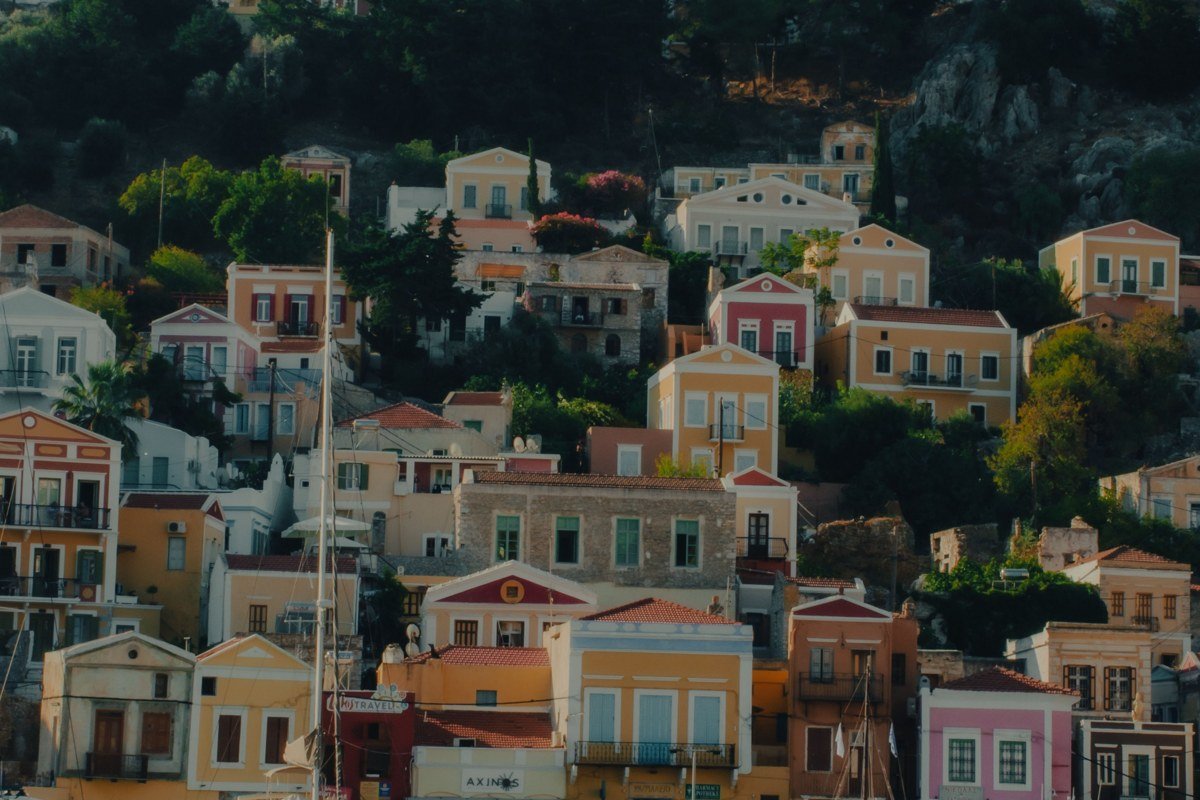
Halki is a tiny island in the Dodecanese with a harbor town called Nimporio that looks like it was assembled by a set designer working on a Wes Anderson film. The mansions lining the waterfront are neoclassical in style, built during a brief period of sponge-fishing prosperity in the late 19th century, and they come in dusty terracotta, faded mustard, peeling sage, and coral. The proportions are grand but the scale is miniature: everything is compressed, operatic, and slightly faded in the best possible way. No motorized vehicles are allowed on the island, so the only sounds are footsteps and the occasional fishing boat. Arrive in May or early October when the light is golden all afternoon and the harbor is uncrowded enough to photograph without strangers in every frame.
Halki pairs naturally with Nisyros as a short Dodecanese loop. See the island-pairing section at the end for route logic.
3. Syros (Ermoupoli specifically)
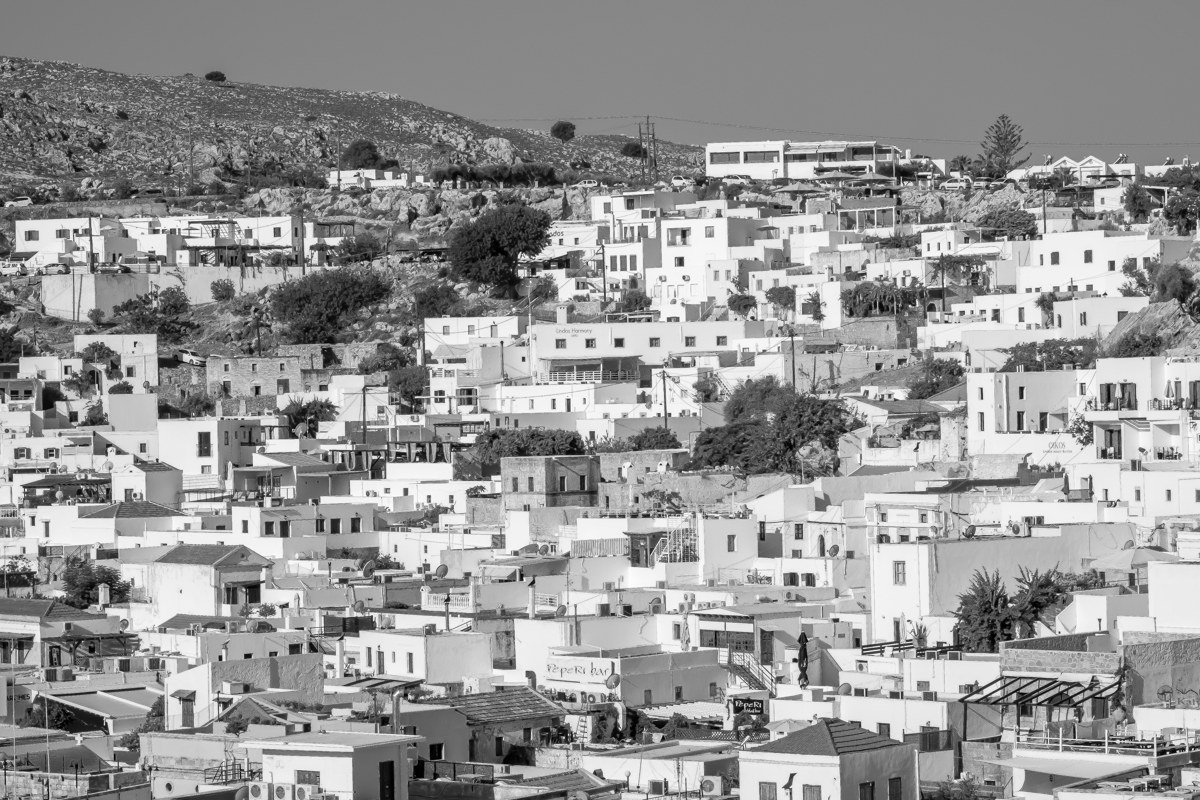
Syros is the capital of the Cyclades and arguably the least-visited island for its size, which is baffling once you see Ermoupoli. The port town is a full-scale neoclassical city, complete with a marble-paved central square (Miaouli Square), a grand town hall that would not look out of place in Vienna, and a hillside Catholic settlement called Ano Syros whose medieval alleyways and domed church feel closer to a Maltese citadel than anything typically associated with Greece. The dual identity of the island, Catholic and Orthodox, Venetian and Cycladic, produces an architectural collision you will not find anywhere else in the Greek islands.
Spend a morning walking between Ermoupoli and Ano Syros (it is steep but short) and save the afternoon for the covered market streets near the port. One specific reason to linger: the island has a long tradition of loukoumades and the local variant of loukoum (Turkish delight), produced here since the 19th century and still sold at small shops near the central square. The Agora market area near the port is the right place to find them, alongside local cheesemakers and small-batch producers that supply the island’s restaurants. Almost no travel publication has bothered to cover this side of Syros, which is exactly why it is worth your afternoon.
4. Nisyros
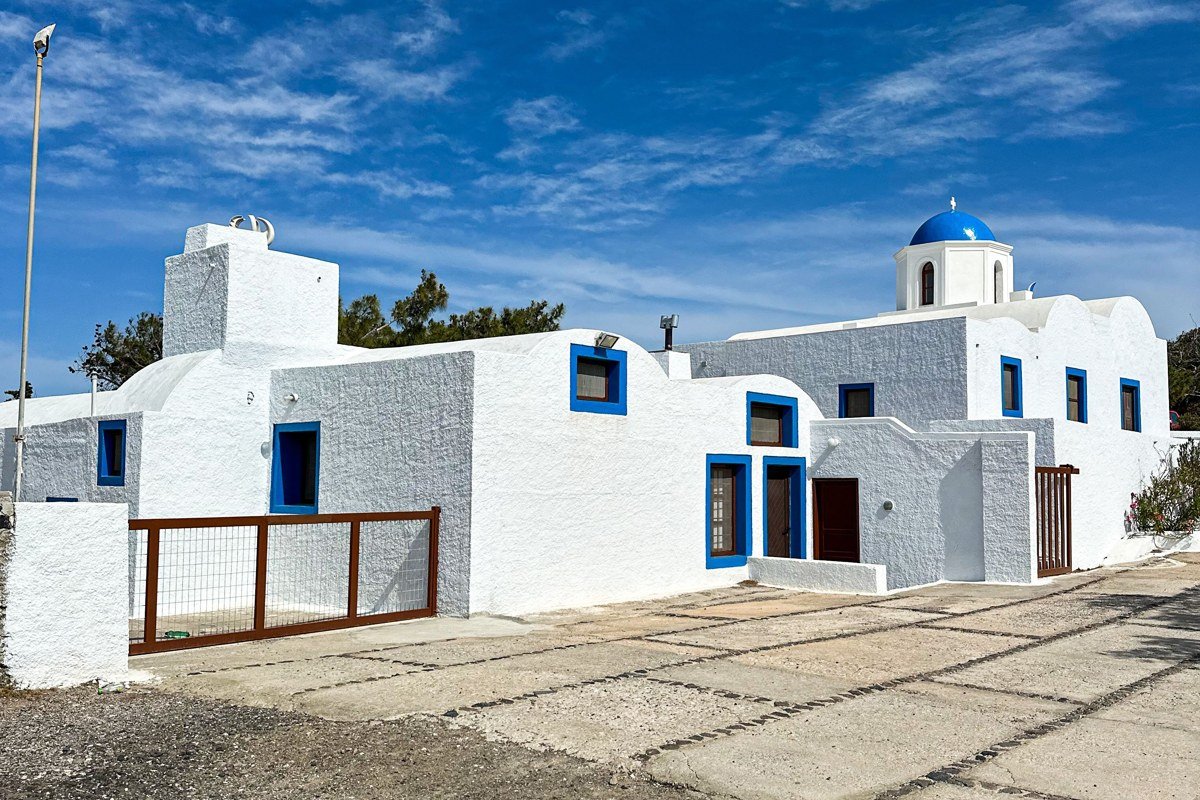
Nisyros is a volcanic island in the Dodecanese, and the geology shapes every visual detail. The village of Mandraki is built on black volcanic rock, which makes the whitewash of the houses glow with an intensity that photographs at almost any time of day. There is a caldera in the interior of the island, still active, and the landscape shifts from cobalt-and-white village to moonscape within about twenty minutes on foot. The monastery of Panagia Spiliani sits carved into a cliff above Mandraki and offers one of the more dramatic vantage points in the Greek islands. Get there on a weekday in June, because Nisyros receives a surge of day-trippers from Kos on summer weekends and that changes the entire mood of the place.
5. Astypalaia
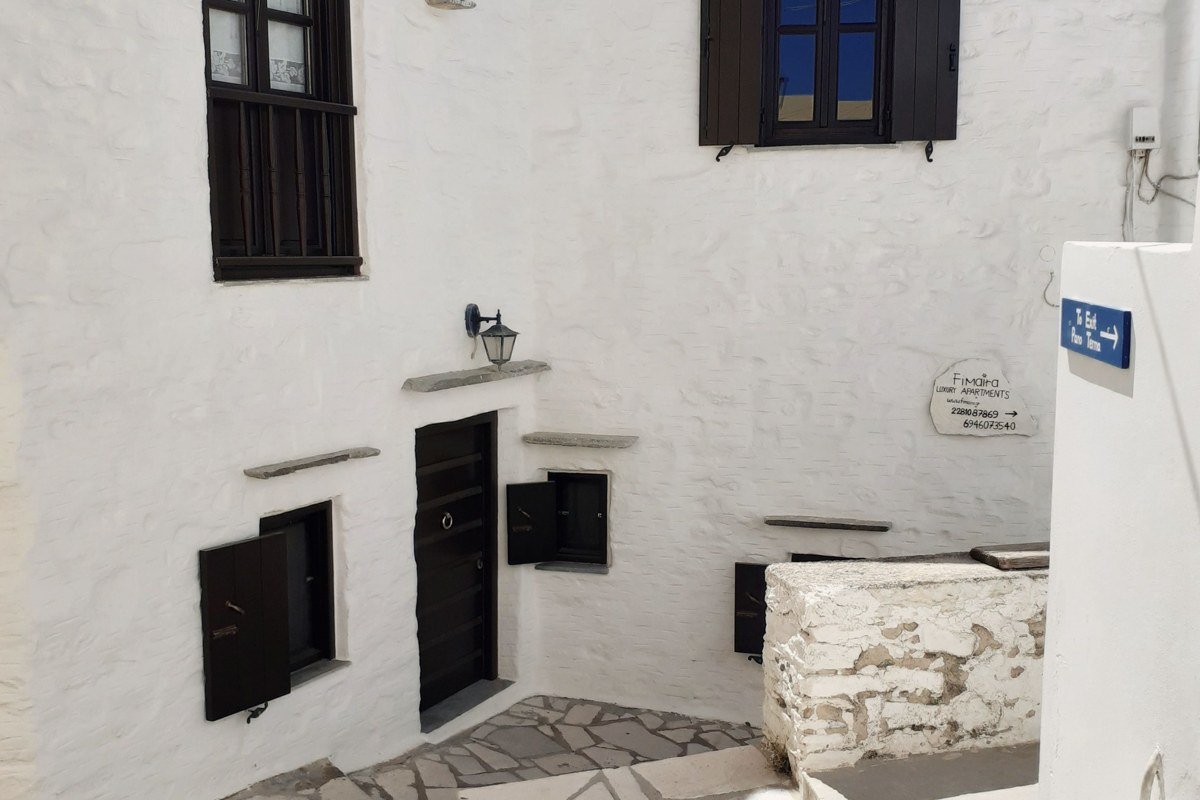
Astypalaia is shaped like a butterfly, and the main town, also called Chora, rewards the kind of architectural attention that a photo cannot fully capture. What makes it distinct from a standard Cycladic village is a layering of two separate influences: a Venetian castle sits at the ridge line, its fortified walls rising above the whitewashed houses in a way that reads as almost medieval Italian from a distance, while the residential streets just below show the Dodecanese tradition of wooden balconies and carved lintels that you do not find in the pure Cycladic islands further west. The windmills at the top are the most-photographed element, but the real visual reward is in those residential streets where outdoor staircases, vaulted passages, and small courtyards create a layered geometry that sits somewhere between Naxos and Rhodes without quite resembling either. The best photographic light hits the upper Chora in the hour before sunset, when the entire hillside turns warm amber and the castle walls appear lit from within. Ferry connections can be infrequent, so plan at least three nights to justify the travel.
6. Kastellorizo (Megisti)
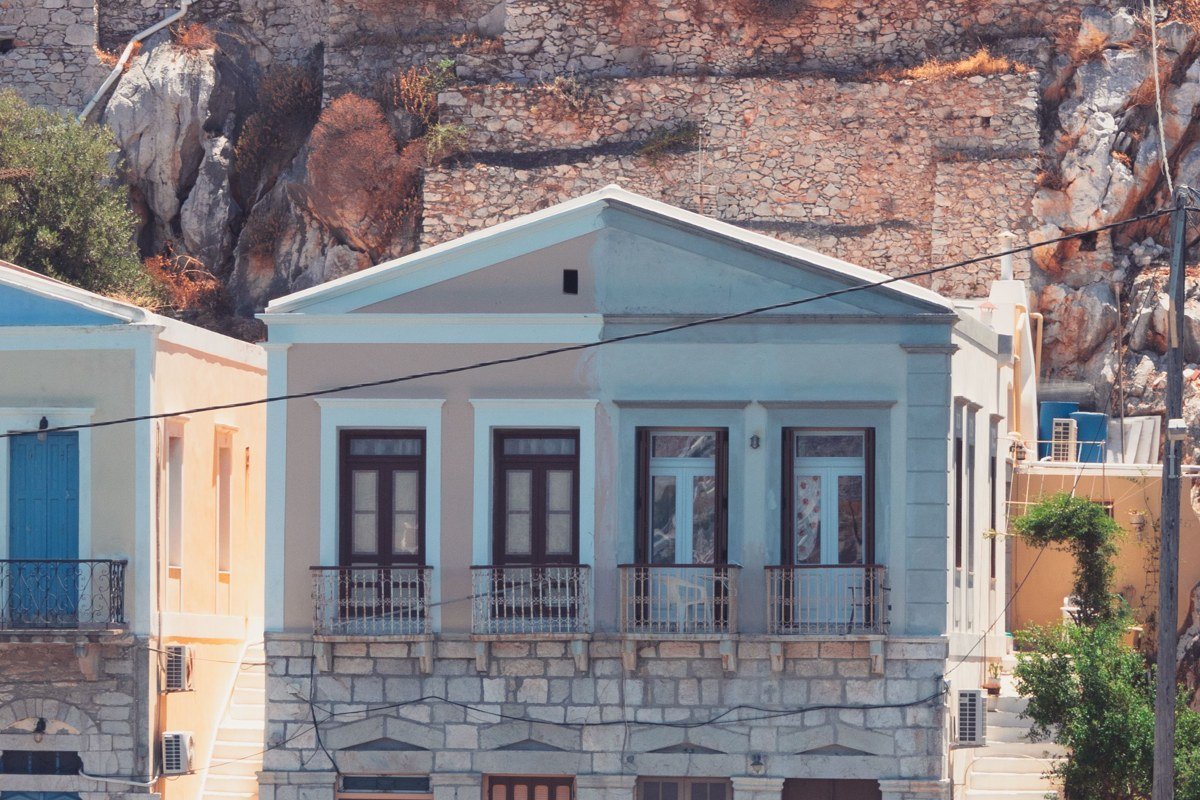
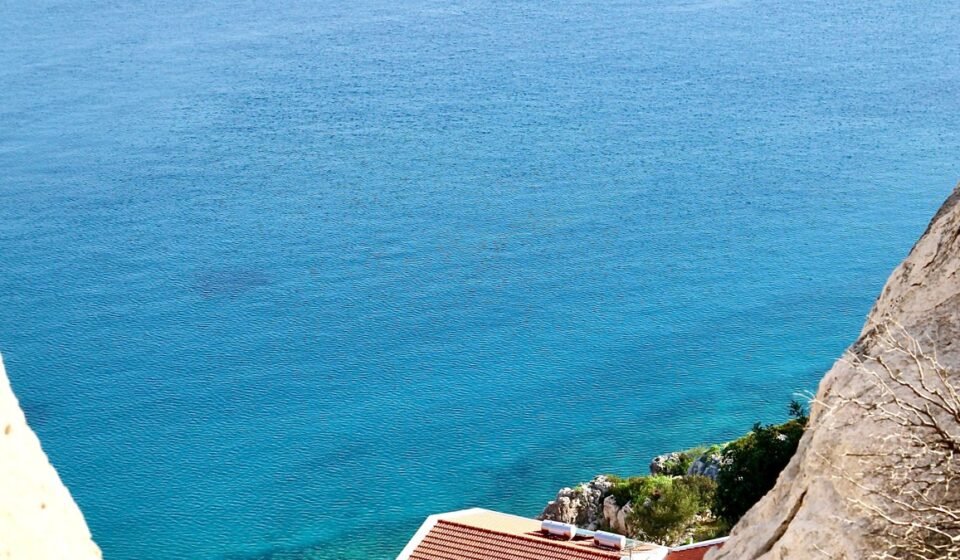
Kastellorizo is Greece’s easternmost island, sitting closer to Turkey than to Rhodes, and the harbor is one of the most visually specific places in the entire Mediterranean. The mansions are Ottoman-era and they come in deep terracotta, ochre, cobalt blue, and seafoam green, their wooden balconies jutting over water so clear it reads as turquoise even on overcast days. The population is tiny, the island has no significant beach, and there is essentially no nightlife. What it has is a perfect harbor loop that takes about fifteen minutes to walk and rewards multiple passes at different times of day. The Blue Cave (Galazia Spilaio), accessible only by small boat, is legitimately one of the most surreal natural spaces in Greece. Because the island receives so few visitors, locals are extraordinarily welcoming and tavernas will often bring you things that are not on the menu.
Getting here takes planning. The ferry from Rhodes takes approximately four hours and does not run daily, so check current schedules through Ferryhopper well in advance and build buffer days on either side. If your itinerary is tight, Sky Express operates small-plane flights from Rhodes to Kastellorizo in around 40 minutes, which changes the calculation considerably and makes a short visit genuinely viable.
7. Hydra
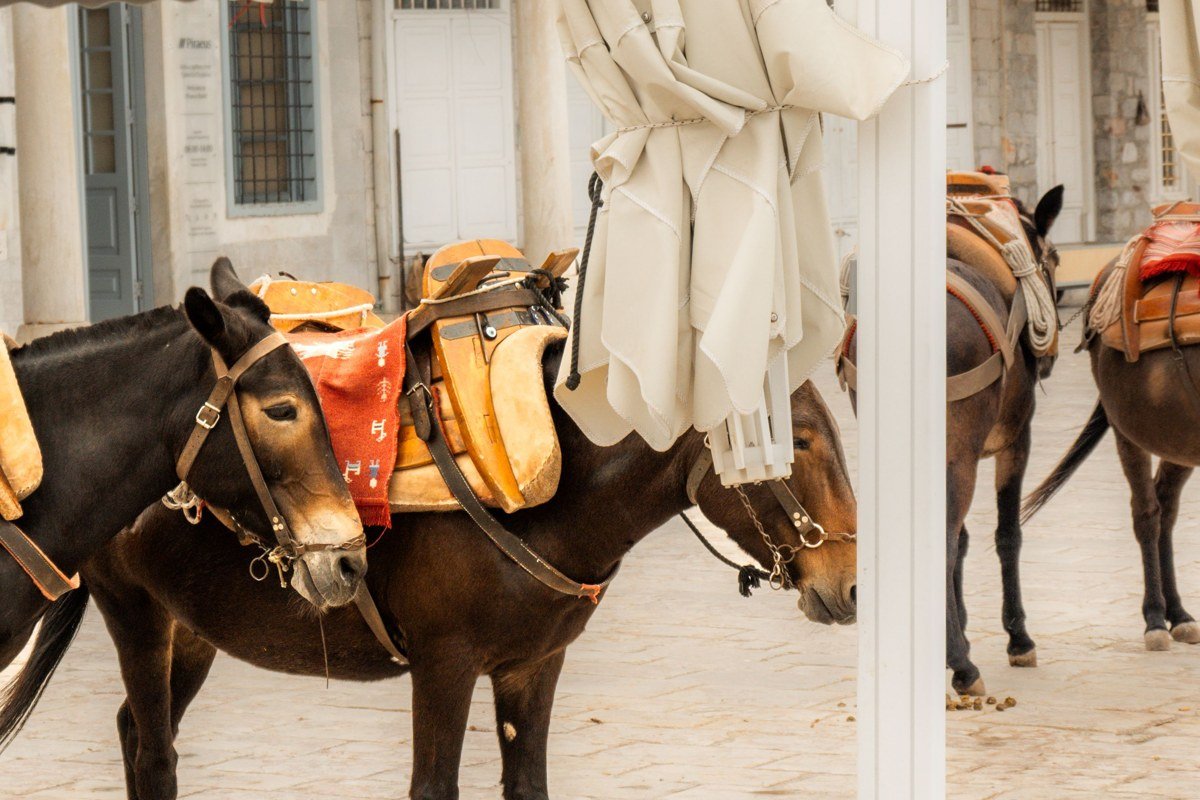
Hydra is technically not a secret, but it remains underrepresented in the aesthetic conversation around hidden Greek islands because people assume it is too close to Athens to be interesting. That assumption is wrong. No motorized vehicles are permitted on Hydra at all, which means the entire island moves at the speed of a donkey, and the stone mansions of the harbor town are almost entirely intact 18th and 19th-century architecture. The palette is different from the Cyclades: grey stone, dark wood, terracotta, and deep navy, with climbing flowers in white and pink doing most of the color work. The interior of the island opens into a dry, dramatic landscape of rocky hills and small monasteries.
Go in April when the wildflowers are out and the ferry from Piraeus takes under two hours. One piece of context that sharpens the island’s character: Leonard Cohen lived here in the 1960s, and the house he rented on the port still stands, identifiable by a small plaque. It draws a certain kind of visitor, but the island is large enough that you can lose them entirely within twenty minutes of walking uphill.
8. Thirasia
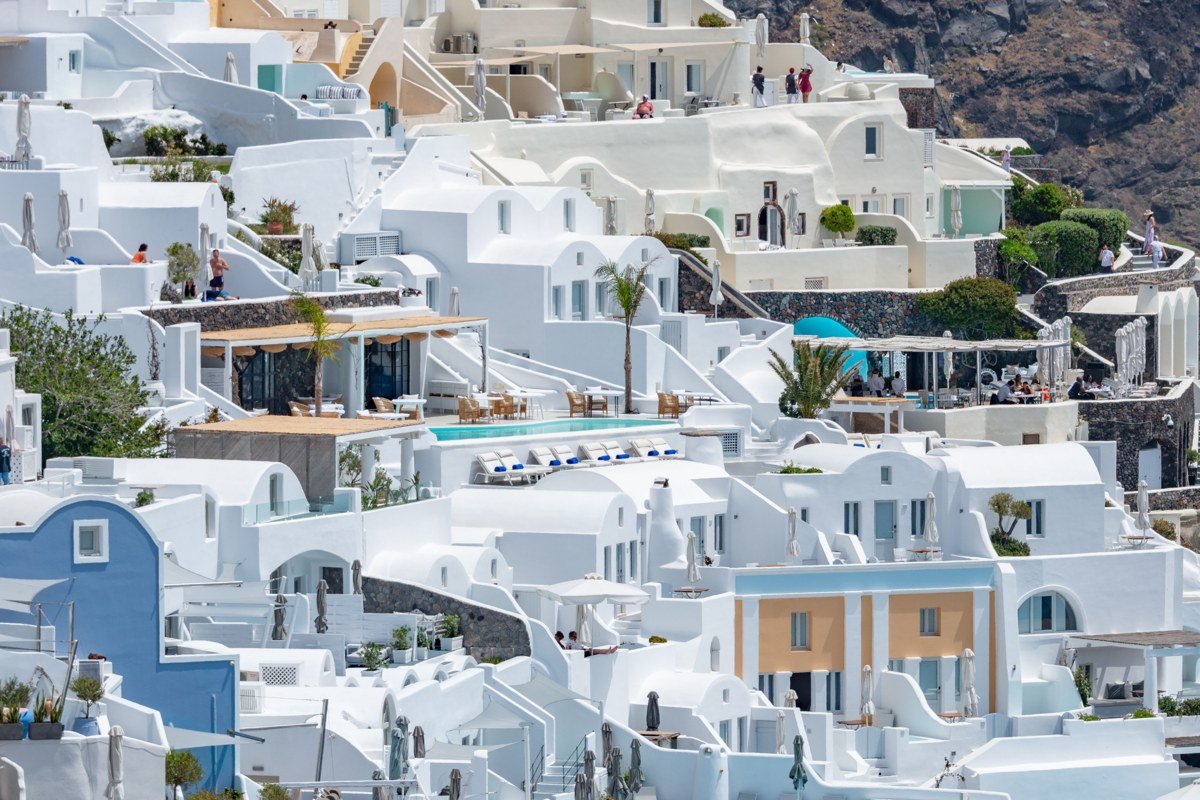
Thirasia is the forgotten twin of Santorini, separated from it by the caldera and by a ferry ride that almost no one bothers to make. The view from Thirasia looking back across the water at Santorini is arguably better than anything you will photograph on Santorini itself. The main village, Manolas, sits at the top of a steep staircase (around 200 steps) and contains a handful of traditional houses, a couple of tavernas, and almost no tourists. The architecture follows the same Cycladic canon as Santorini but without any of the boutique hotel renovation, which means it looks lived-in, slightly irregular, and photographically much more interesting.
Overnight accommodation in Manolas is genuinely thin: a few rooms are available through local arrangements, and these rarely appear on major booking platforms. The practical workaround, and it is a good one, is that the ferry from Fira on Santorini runs multiple times daily during the main season, making a same-day trip entirely viable. You can cross in the morning, walk up to Manolas, eat lunch at one of the tavernas with the caldera spread out in front of you, and return in the afternoon having seen the better view and none of the crowds. That itinerary costs almost nothing and filters the experience in a way that money cannot buy on the other side of the caldera.
9. Arki
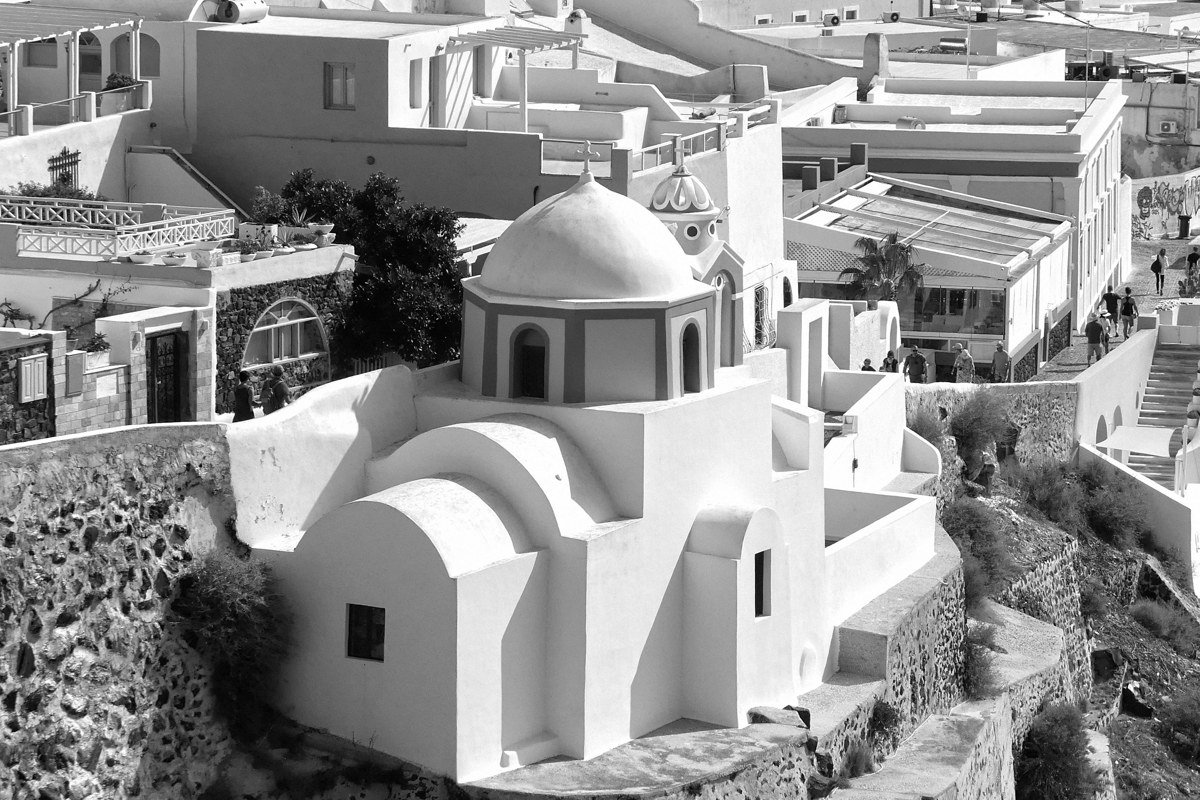
Arki has a permanent population of around twenty people, no paved roads, and a settlement of whitewashed cubic houses clustered around a small harbor that looks precisely like a scale model of a larger Greek village. The proportions are slightly off in a way that photography captures beautifully: the chapel dome is very large relative to the houses, the dock is very long relative to the boats, and the whole thing sits against a sea that is the kind of blue that usually requires a filter to reproduce. There is one taverna and it is excellent.
Getting here requires a small ferry from Patmos or Lipsi, with the journey from Patmos taking roughly one hour under normal conditions. The ferry does not run daily and the schedule shifts by season, so treat the crossing as weather-dependent and build a loose day on Patmos as a buffer. Arki is for the traveler who wants to see what these islands looked like before anyone built an infinity pool.
How to Combine These Islands
The geography of the Greek islands makes certain pairings far more logical than others, and planning around a shared ferry hub can save both time and money.
Dodecanese loop from Rhodes: Kastellorizo, Halki, and Nisyros are all reachable from Rhodes, making them natural companions in a single trip. A workable sequence is Rhodes to Kastellorizo by plane (Sky Express, roughly 40 minutes) or ferry (roughly four hours), then back to Rhodes by ferry and onward to Halki (a short hop of under an hour from the nearby port of Kamiros Skala) and Nisyros (accessible via Kos or direct from Rhodes). Budget ten to twelve days for all three without feeling rushed.
Dodecanese eastern loop from Patmos: Arki sits between Patmos and Lipsi and integrates naturally into a quieter eastern Dodecanese itinerary. Patmos to Arki takes roughly one hour by ferry; Arki to Lipsi is a comparable short crossing. These three islands together make a low-key four to five day sequence for travelers who want minimal infrastructure and maximum stillness.
Cyclades and the caldera: Folegandros, Thirasia, and Astypalaia can be linked within a single Cyclades itinerary, though Astypalaia requires more planning due to infrequent ferries. Thirasia is best treated as a half-day or day trip from Santorini rather than a standalone destination. Folegandros is reachable from Santorini in around two hours by ferry and pairs well as a before-or-after stop.
Saronic and Cyclades from Athens: Hydra and Syros are both reachable from Piraeus and make a logical two-island pairing for a trip based out of Athens. The ferry to Hydra takes under two hours; Syros is roughly four hours. They share almost nothing aesthetically, which is precisely what makes them work well together.
Practical Takeaways
The islands on this list share a few logistical realities worth knowing before you book.
Ferry connections are the defining constraint. Kastellorizo, Arki, and Thirasia all require planning around infrequent or indirect routes. The Open Seas ferry planner and the Ferryhopper booking site together cover most routes in the Dodecanese and Cyclades. Build buffer days into any itinerary that includes these three.
Shoulder season is not just a budget tip, it is an aesthetic one. May, early June, and September give you the right light, manageable crowds, and tavernas that are fully open but not overwhelmed. July and August on the smaller islands can be surprisingly packed because the same travelers who have discovered them tend to arrive at the same time.
Accommodation on the smallest islands (Arki, Thirasia, Nisyros in high season) is genuinely limited. Book direct where possible, by email or phone, because these properties often do not appear on major booking platforms at all. That friction is the last reliable filter keeping these places on the quieter side of the category.