The Perfect 7-Day Morocco Itinerary: A Day-by-Day Tourist Travel Plan for First-Time Visitors (Riads, Souks & Desert Stops)

At 5:40 a.m. on a dune in the Erg Chebbi, the sand goes from grey to rose to a bright, almost violent orange in about eight minutes. I’ve watched people fumble their phones the whole time because nobody told them the light moves that fast. That single scene is why half of Pinterest is currently flooded with Morocco boards — and why a badly planned trip wastes the one morning you traveled 350 km to see.
This Morocco travel itinerary is built to prevent exactly that. It’s a real, copyable 7-day route from Marrakech through the Atlas Mountains to the Sahara and back, with honest travel times, rough costs in dirham and USD, and the small logistical decisions that make or break a first visit.
Before You Book: The Route Decision That Shapes Everything
The single biggest choice is whether you loop from Marrakech or go point-to-point across the country. For a first-time, 7-day trip, loop from Marrakech. It minimizes wasted backtracking and puts you within reach of the desert.
Here’s the honest trade-off:
| Route style | Best for | Downside |
|---|---|---|
| Marrakech loop (this plan) | Deserts, mountains, one “big” city | Skips Fes and the coast |
| Marrakech → Fes overland | Imperial cities + medinas | Rushed; long transit days |
| Fly-in/fly-out Fes + Chefchaouen | Blue city + northern medinas | No Sahara; different vibe |
If your heart is set on the blue-washed streets of Chefchaouen or the vast tannery-lined medina of Fes, you genuinely need 10 days. Trying to cram Sahara and Fes and Chefchaouen into a week means five hours in a car most days. Don’t.
When to go: March–May and September–early November. Summer in the desert regularly tops 45°C (113°F). December–February is beautiful and clear but freezing at night in the dunes — bring a proper jacket.
Check the Ramadan dates before you lock anything in. Ramadan shifts about 11 days earlier each year, so it can land squarely in your travel window without you realizing it. During the fasting month, many restaurants — especially outside tourist zones — stay shuttered until iftar at sundown, souk vendors keep shortened and unpredictable hours, and drivers may be low-energy through the afternoon. None of this makes Morocco off-limits: the nightly break-fast is genuinely magical, the streets come alive after dark, and the atmosphere is unlike any other time of year. But you’ll need to adjust — carry snacks, plan lunches around hotel restaurants that stay open for tourists, and don’t expect the daytime bustle you see in photos. Treat it as a season-check item, not a deal-breaker.
The 7-Day Morocco Travel Itinerary at a Glance
- Day 1: Arrive Marrakech — settle into a riad
- Day 2: Marrakech medina, souks & gardens
- Day 3: Drive over the Atlas to Aït Benhaddou & Ouarzazate
- Day 4: Todra Gorge & Dades Valley to the desert edge
- Day 5: Merzouga — camel trek & night in the dunes
- Day 6: Sunrise in the Sahara, long drive back toward the Atlas
- Day 7: Return to Marrakech / departure
You can run this with a private driver (most comfortable), a small-group tour, or self-drive. More on that below — it matters.
📱 Practical Logistics: Set These Up on Arrival
Get a local SIM at the airport or a Maroc Telecom / Inwi shop. Both cover the whole route; Maroc Telecom generally has the edge on rural and desert coverage, Inwi is often marginally cheaper. A data-heavy tourist package runs roughly 50–80 MAD for a week’s worth of gigabytes — bring your passport, as registration is required.
Download offline maps before you leave the city. Grab both your Google Maps region and Maps.me for the areas you’ll cross — Maps.me handles medina alleys and unpaved kasbah tracks better, and neither needs signal once cached. Coverage genuinely disappears between towns in the mountains.
WhatsApp is the operating system of Moroccan travel. Your driver, your riad, your desert camp — nearly all of them coordinate over WhatsApp, not email or phone calls. Confirm pickups, send your arrival time, share your live location to the porter meeting you. Save every contact the moment you book.
Day 1 — Land in Marrakech, Sink Into a Riad
Fly into Marrakech Menara (RAK). A pre-arranged grand taxi to the medina costs around 150–200 MAD (~$15–20); agree the price before you get in, because the meter is a fiction here.
Stay inside the medina in a riad — a traditional house built around an interior courtyard. This is not just aesthetic (though the tiled courtyards and rooftop terraces are the exact thing filling your Pinterest feed); it means you can walk to everything. Mid-range riads run 500–900 MAD (~$50–90) a night including breakfast on the terrace.
A few to anchor your search: Riad Kniza sits at the mid-to-high end (roughly 1,500–2,500 MAD/night) — a museum-quality restored family home with impeccable service, worth it for a splurge night. Riad BE Marrakech lands squarely mid-range (around 800–1,200 MAD) with a photogenic courtyard pool and a rooftop. For the budget-conscious, Riad Dar Zitoun and similar guesthouses come in around 400–600 MAD with the same courtyard-and-terrace bones and breakfast included. Book your first and last nights early — arriving jet-lagged with nowhere confirmed is a miserable way to start.
Spend the evening easing in. Walk to Jemaa el-Fnaa as the sun drops. First the orange-juice carts line up (5 MAD a glass at the honest stalls — not the tourist-facing ones charging triple), then the smoke rises as the food stalls fire up their grills. Push past the aggressive touts near the entrance and head for the working end of the square. Look for a woman folding msemen — the flaky, layered griddle pancake — and eat it hot with a drizzle of honey; it’s the perfect jet-lag food. If you’re braver, the snail-soup carts (babbouche) ladle out a peppery cumin-and-thyme broth for a few dirham a bowl — locals swear by it, and the vendors are less interested in tourists than in their regulars. Skip the harira stalls that hover in the 14-ish numbered zone if there’s no queue of Moroccans; the good ones always have one. Don’t try to see anything else tonight. You’ll be jet-lagged and the medina is genuinely disorienting after dark.
Insider tip: Save your riad’s exact location as an offline pin and screenshot the walking route from the nearest square. Medina alleys aren’t reliably mapped, and your phone data may lag. Riads usually send a porter to meet you at a landmark taxis can reach — WhatsApp them your ETA so they’re waiting.
Day 2 — Marrakech Medina, Souks & the Photogenic Big Hitters
This is your one full city day. Front-load it.
Morning (8–8:30 a.m. start):
– Bahia Palace (70 MAD) — go right at opening. By 10:30 the courtyards are shoulder-to-shoulder and unphotographable.
– Ben Youssef Madrasa (50 MAD) — the restored Quranic school with the zellij tilework everyone repins. Also best early.
Midday: Dive into the souks. Navigate by trade: the dyers’ souk, the leather souk, the metalworkers whose hammering you’ll hear before you see them. Getting lost is the point, but set a rough time limit or you’ll lose two hours.
Afternoon:
– Jardin Majorelle & the YSL connection (cobalt-blue villa, ~170 MAD combined with the Berber museum) — buy the timed ticket online in advance or the queue eats your afternoon.
– Alternatively, the free-to-wander Le Jardin Secret in the medina is calmer and cheaper.
Evening: Rooftop dinner overlooking Jemaa el-Fnaa. This is the meal to order pastilla — the classic Marrakchi pie of shredded pigeon (or chicken) under crisp warqa pastry, dusted with cinnamon and powdered sugar. It sounds strange and tastes extraordinary. A tagine and mint tea runs 80–120 MAD; pastilla usually adds a little more.
Haggling reality check: Sellers open at roughly 3–4× the fair price. Counter at about a third of their first number and settle somewhere in the middle. Walking away genuinely works. A quality leather pouf costs 200–350 MAD unstuffed; anyone quoting 800 is reading you as a tourist.
A word on photography. In the souks, the fair etiquette is to buy something small or ask first before pointing a lens at a vendor’s stall — a nod and a “mumkin?” (may I?) goes a long way, and a 5–10 MAD tip for a portrait keeps things friendly. The tannery workers get a special mention: raising a camera at them without a word is a reliable way to start an argument, because outsiders have been photographing their labor for decades without asking or paying. A moment of eye contact, a gesture, a small tip — that’s the difference between a warm interaction and being chased off. Snake charmers and water-sellers in Jemaa el-Fnaa will always expect money if you shoot them.
Day 3 — Over the High Atlas to Aït Benhaddou
Today you leave the city. This is where a driver earns their fee. The road over the Tizi n’Tichka pass (2,260 m) is spectacular and switchbacked, and tackling it yourself on day three of jet lag while dodging trucks is not the fun kind of adventure — though if you’re driving (see the transport section below), leave early and take it slow.
Drive time: Marrakech to Aït Benhaddou is about 4 hours with photo stops.
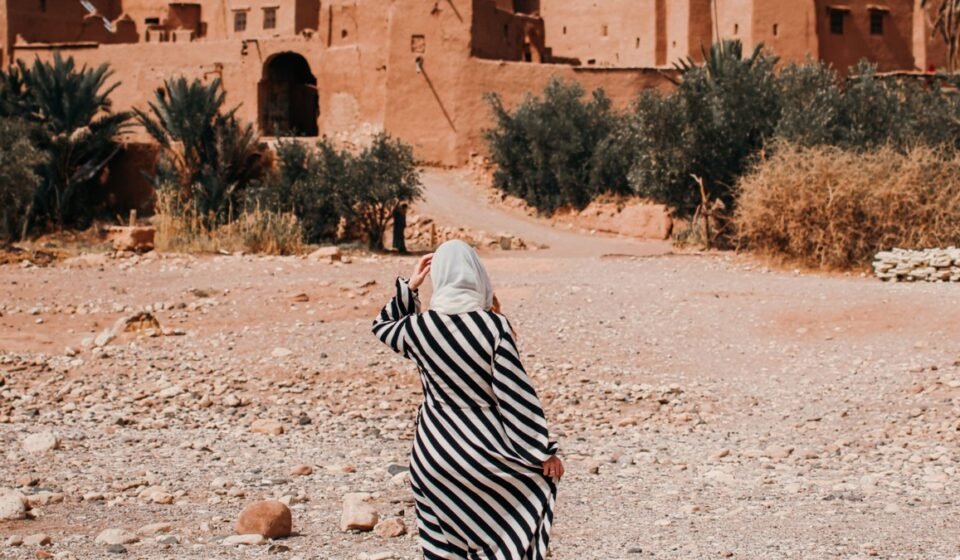
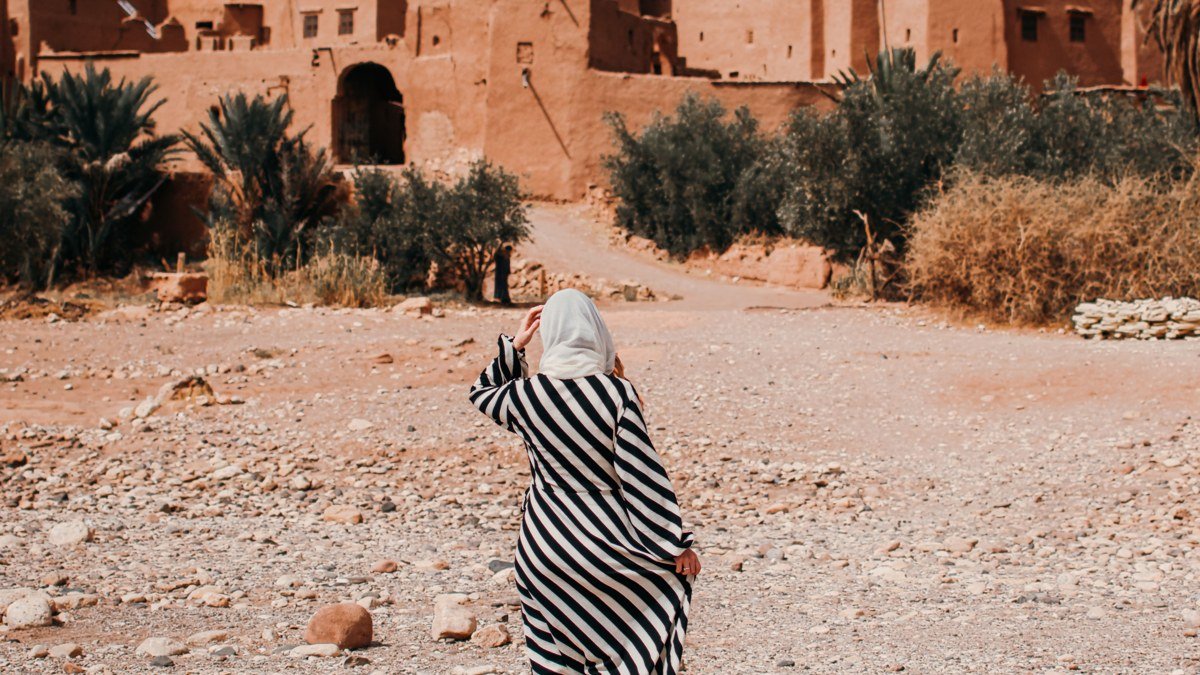
Aït Benhaddou is the mud-brick ksar you’ve seen in Gladiator and Game of Thrones — a fortified village of stacked earthen kasbahs against bare mountains. Cross the (usually shallow) river, climb to the top for the panorama, and time your arrival for late afternoon light if you can.
Continue 30 minutes to Ouarzazate for the night, or better, stay in a kasbah guesthouse near Aït Benhaddou itself so you catch it empty at sunrise. Kasbah stays: 400–700 MAD.
Insider tip: Have your driver stop at Telouet Kasbah, a crumbling former palace off the main road that 90% of tours skip. It’s raw, half-ruined, and you’ll often have it to yourself — a much better story than the crowded main village.
Day 4 — Todra Gorge & the Road of a Thousand Kasbahs
A long but scenic driving day along the Dades Valley, nicknamed the Road of a Thousand Kasbahs for the earthen fortresses dotting the palm groves.
Key stops:
– Skoura oasis — palmeraie and the photogenic Kasbah Amerhidil
– Dades Gorge — the famous hairpin switchbacks that snake up the rock (a genuine Pinterest magnet; shoot from the café viewpoints above). Break here for mid-morning mint tea at a terrace café like Auberge des Gorges du Dades, perched over the switchbacks — it’s the shot everyone comes for, and you get it with a glass in hand.
– Todra Gorge — 300-metre vertical canyon walls with a river running through a gap barely wide enough for the road
Timing the light and the crowds: Aim to reach Todra around 11 a.m., which is roughly when the sun clears the rim and drops a band of direct light onto the gorge floor — the walls go from flat shadow to glowing ochre. That said, 11 a.m. is also peak tour-bus hour. The fix: get to the main parking area early, then walk about 200 m upstream past the cluster of cafés and buses to where the walls pinch in to around 10 m apart. The day-trippers rarely bother, so you get the narrowest, most dramatic stretch nearly to yourself. If your schedule is flexible, arriving before 10 a.m. or after 3 p.m. thins the crowds dramatically either way.
Drive time: roughly 5–6 hours total with stops. It’s long, but the landscape changes constantly, so it doesn’t drag the way a highway would.
What to eat here: The Dades Valley is mechoui country — slow-roasted lamb, pulled tender off the bone and eaten with bread and cumin. Ask your driver or kasbah host where the locals go; it’s not always on the tourist menu, and it’s worth the detour.
Overnight near Tinghir or push on toward Merzouga. Most itineraries stop short of the dunes tonight to keep tomorrow manageable.
Honest note: If you’re prone to car sickness, take something before the gorges. The switchbacks are relentless.
Day 5 — Merzouga and the Camel Trek Into Erg Chebbi
The payoff day. You reach Merzouga, the village at the edge of Erg Chebbi — the towering, classic Sahara dunes (some rising 150+ metres).
Arrive by mid-afternoon. Around 4–5 p.m., you’ll meet your camel trek (technically dromedaries) or a 4×4 transfer into the dunes to a desert camp.
- Camel trek: ~1–1.5 hours over the sand at golden hour. Uncomfortable but iconic, and the reason you came.
- 4×4: faster and easier on your back if you have knee or hip issues.
Desert camps range wildly:
– Standard camp: shared or basic tents, communal tagine dinner, drumming around the fire — 300–500 MAD/person
– Luxury “glamping”: private tents with real beds and en-suite bathrooms — 1,000–2,500+ MAD/person
Dinner is tagine under more stars than you’ve likely ever seen, followed by Berber drumming. Then it goes silent and genuinely dark.
Insider tips:
– Bring a headlamp, a power bank, and socks + closed shoes for the walk — sand gets in everything.
– Nights are cold even in shoulder season. Camps provide blankets but bring a layer.
– Tip your camel guide 20–50 MAD; they walk the whole way leading you.
Day 6 — Sahara Sunrise, Then the Long Road Back
Wake before dawn. Climb the nearest high dune (harder than it looks — two steps up, one slide back) and watch the sunrise I described at the top. Give it 15 minutes; the color show is over quickly.
Then comes the reality of a loop: you have to drive back. From Merzouga toward the Atlas foothills is roughly 7–8 hours, so most itineraries break it with an overnight in Boumalne Dades or return via a different pass.
To make the day bearable:
– Leave by 8–9 a.m. after breakfast at camp
– Break the drive at a scenic café — the Dades hairpins have several
– Consider overnighting again in Ouarzazate or the Dades Valley rather than pounding all the way to Marrakech in one shot
Trade-off: Some 3-day desert tours do return to Marrakech on this day in a single ~9-hour haul. It’s doable but brutal. If your flight allows, split it.
Day 7 — Back to Marrakech / Departure
If you overnighted in the Dades or Ouarzazate, you’ll re-cross the Tizi n’Tichka and reach Marrakech by early-to-mid afternoon.
Use any remaining time for what you skipped: a hammam (traditional steam-and-scrub bath — a public one costs ~50 MAD, a spa version 250–400 MAD), last-minute souk shopping, or a quiet mint tea on a rooftop before the airport.
Airport buffer: Leave the medina at least 2 hours before check-in. Marrakech traffic and the walk-out from the medina to a taxi both eat time.
🍽️ What to Eat: A Cheat-Sheet
Morocco is one of the great food destinations, and it’s easy to eat well without hunting. Prioritize these:
- Amlou at breakfast — a rich, spreadable paste of argan oil, almonds, and honey, served with bread on riad terraces. Once you taste it you’ll want to smuggle a jar home (buy it from a co-op, not a tout).
- Pastilla in Marrakech — the sweet-savory pigeon-and-pastry pie; a rooftop restaurant is the place to try it.
- Mechoui in the Dades Valley — slow-roasted lamb, best sourced through a local recommendation.
- Msemen with honey at Jemaa el-Fnaa — flaky griddle pancake, the ideal street snack.
- Friday couscous — many families and restaurants serve couscous only on Fridays. Plan a Friday lunch around it.
What This Trip Actually Costs (Per Person, Mid-Range)
Rough estimates for one person, sharing a room, on a mid-range budget:
| Item | 7-day estimate (MAD) | ~USD |
|---|---|---|
| Riad/kasbah/camp lodging | 3,500–5,000 | $350–500 |
| Private driver (shared between 2–4) | 2,500–4,000 | $250–400 |
| Food & drink | 1,000–1,500 | $100–150 |
| Entry fees & activities | 700–1,000 | $70–100 |
| Camel trek + desert camp | 400–800 | $40–80 |
| Tips & extras | 400–600 | $40–60 |
Ballpark: roughly $850–1,300 per person excluding international flights, if traveling as a pair or small group. A private driver split three or four ways is where the real savings hide.
Getting Around: Driver vs. Self-Drive vs. Group Tour
- Private driver (recommended for most first-timers): ~2,500–4,000 MAD total for the multi-day loop. You get local knowledge, no navigation stress, and stops where you want. Split across a group, it’s shockingly reasonable.
- Self-drive: Genuinely worth considering under the right conditions. Car rental runs ~300–400 MAD/day, and for a two-person group the driver cost isn’t shared across enough people to make a private driver cheap — so self-driving can save real money and hand you total freedom over your stops. It works well if you’re a confident driver comfortable with mountain switchbacks, you’re traveling outside winter (December–February can bring ice and snow on the Tizi n’Tichka pass), and you’re relaxed about police checkpoints (be polite, have your papers ready, keep to speed limits — they’re routine, not sinister). Where it stops making sense: solo travelers on a tight schedule, anyone nervous behind the wheel, or trips squeezed into deep winter. If that’s you, take the driver.
- Small-group tour: Cheapest and most social, but you’re on a fixed schedule and can’t linger at that perfect kasbah for photos.
Common Mistakes First-Timers Make
1. Trying to add Fes to a 7-day loop. It turns half your trip into transit. Save Fes for a separate northern route.
2. Booking a “1-night desert tour” from Marrakech. These are the notorious 3-day sprints with ~18 hours of driving for one desert night. You’ll be exhausted and see the country through a windshield.
3. Underestimating drive times. Google’s estimates don’t account for switchbacks, livestock on the road, and photo stops. Add 20–30%.
4. Not carrying cash. Small towns, camps, and many riads are cash-only. Withdraw dirham at ATMs in Marrakech before heading into the mountains; ATMs get sparse fast.
5. Ignoring the dress code. Morocco is relaxed with tourists, but in medinas and villages, covering shoulders and knees earns warmer treatment and fewer stares — especially for women. You don’t need to cover up head-to-toe; a scarf and loose layers are enough. Save the shorts and tank tops for the desert camp and the riad pool.
6. Traveling during Ramadan without adjusting. As flagged up top, this isn’t a mistake to avoid Ramadan — it’s a mistake to arrive unaware of it. Check the dates, expect daytime closures, and lean into the after-dark energy rather than fighting it.
7. Dehydrating in the desert. People forget the Sahara is dry heat and don’t drink enough. Bring 2+ litres per person into camp.
8. Photographing people without asking. Snake charmers, water-sellers, and market vendors in Jemaa el-Fnaa will demand money (5–20 MAD) if you shoot them — and the tannery workers, understandably, resent silent lenses aimed at them. Ask first, tip for portraits, or shoot wide.
Insider Tips a Guidebook Won’t Give You
- The best riad photos are at breakfast, when the courtyard light is soft and it’s empty. Ask to shoot before other guests come down.
- Buy your spices, argan oil, and amlou from co-operatives, not medina stalls — better quality and fixed, fair prices.
- Learn five words of Darija (Moroccan Arabic): salam (hi), shukran (thanks), la shukran (no thanks — for touts), bshhal? (how much?), ghali bzzaf (too expensive). It changes every interaction.
- Book the desert camp with genuine reviews and GPS coordinates. “Merzouga” is a huge area, and cheap camps are sometimes on the scrubby edge, not the tall dunes.
Your Takeaway
Copy the day-by-day plan above, then do three things today: book a medina riad for your first and last nights (Riad Dar Zitoun for budget, Riad BE for mid-range, Riad Kniza to splurge), message two private-driver services for a quote on the Marrakech–Merzouga loop, and reserve a desert camp with real GPS coordinates on the tall dunes of Erg Chebbi. Set up your SIM and offline maps the moment you land, save every contact to WhatsApp, and check where Ramadan falls before you book flights. Lock those in and the rest of this Morocco travel itinerary falls into place — leaving you free to be fully awake on that d